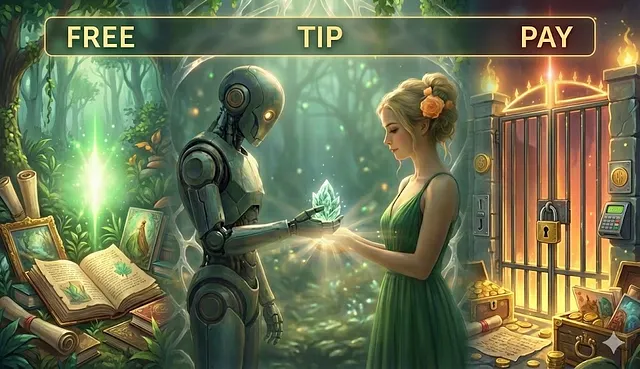
tl;dr Humans crave novelty. Agents crave data. Creators crave income. Stablecoins move value. Incentives create alignment.
One of a16z’s recent posts, 8 big ideas for 2026, touched on a topic that stuck with me: the invisible tax on the open web.
Table of Contents
- Table of Contents
- Two problems collide
- An old but new primitive
- Why would humans tip humans?
- Why would agents tip humans?
- This is not about paywalls
Two problems collide
The core idea is simple and uncomfortable.
“AI agents extract data from ad-supported sites (the context layer), providing convenience to users while systematically bypassing the revenue streams (like ads and subscriptions) that fund the content.”
And the only real path forward is a system that:
“could include models like next-generation sponsored content, micro-attribution systems, or other novel funding models. Existing AI licensing deals are also proving to be a financially unsustainable Band-Aid, often compensating content providers with a fraction of the revenue they’ve already lost to AI-cannibalized traffic.”
This reminded me of an observation Ilya Sutskever (ex Chief Scientist of OpenAI) made in his 2024 NeurIPS talk. At minute 8, he states that data, the fossil fuel of AI, is not growing!
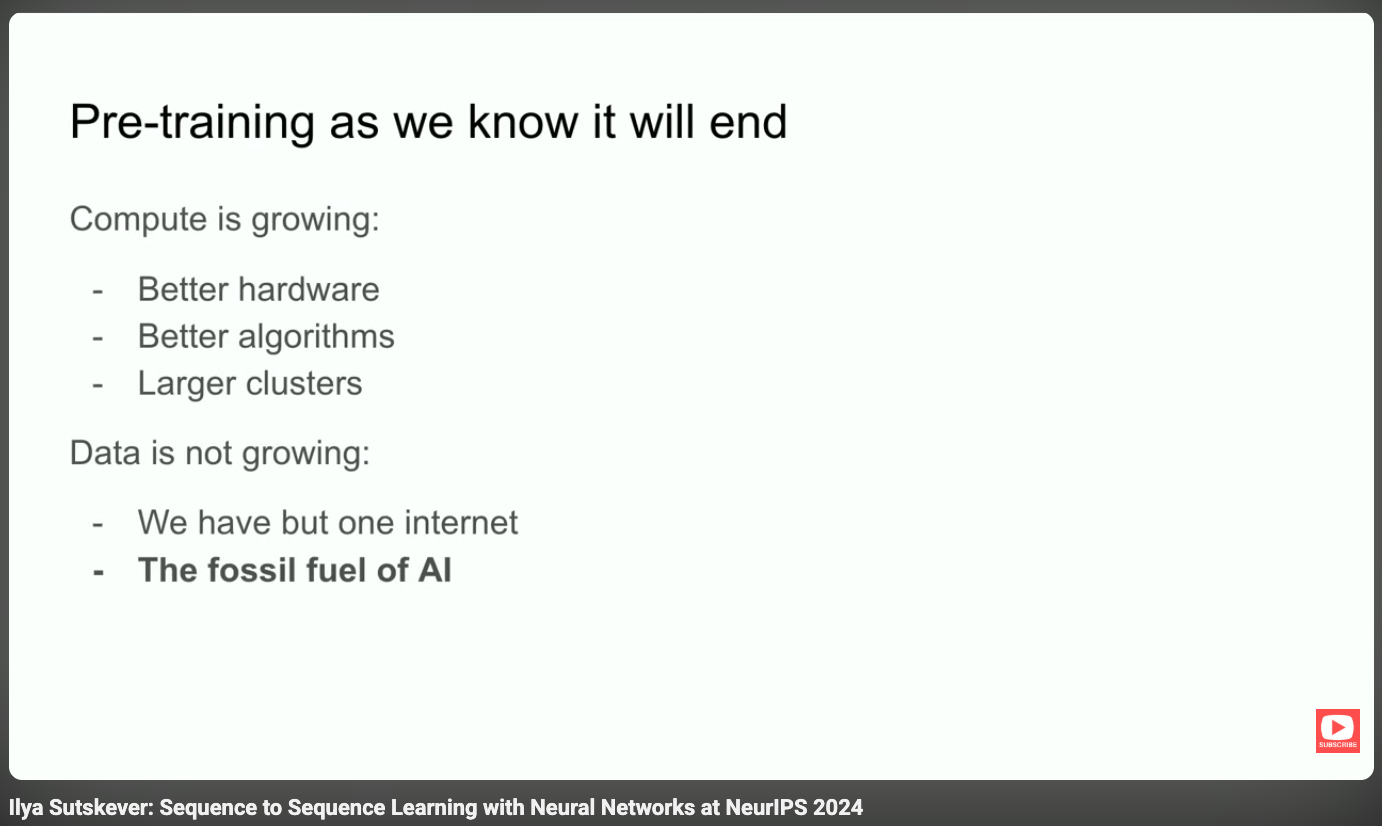
Those two problems collide.
If original human content becomes economically irrational to produce, and AI systems depend on fresh, diverse, ground-truth data, the system eats itself.
So the question becomes: How do we fund original content on the open web without rebuilding paywalls, killing distribution, or forcing creators into platform lock-in?
And how do we do it in a way that works for both humans and agents?
An old but new primitive
Our answer is micro-tipping.
Not tipping as charity. Not tipping as guilt. Not tipping as a replacement for subscriptions, payments or paywalls.
Tipping is a lightweight, optional economic signal that creates alignment.
It uses AI, stablecoin payment rails, and leverages incentives that operate at both human and machine scales. It does not require accounts, contracts, or commitments. And it works everywhere.
We are already building this at Grove. We are early, but you can see the direction if you take a look.
Why would humans tip humans?
There are two reasons:
- It feels good
- It’s a lottery ticket to an experience
Tipping feels good when it is optional and low-stakes. The person sending the tip feels good, as does the person receiving it. If you micro-tip two cents at a time, you can feel good dozens of times a day.
Large payments feel like investments. Subscriptions feel like commitments. They come with expectations, pressure, deliberations, and second thoughts. Small payments feel expressive. They say, “I liked this,” without asking for anything in return.
Most importantly, this doubles by enabling a missing incentive platform that connects supporters to creators, irrespective of the platform they’re on.
Every tip can double as a lottery ticket.
Leveraging stablecoin rails uses a public ledger. Grove, or anyone else, can build a platform or leaderboard where creators can connect with their audience.
For example, if you make “A life in the day of” videos, you’re tipping your way into a chance to spend a day in the life of the video creator. If it’s an apparel maker, you’re tipping your way into sweepstakes for that free pair of sneakers.
This is true interoperability. Anyone can see who tipped whom, what was at stake, and who won. It is internet native, platform-agnostic, and AI-first.
A small chance at a meaningful upside, access, recognition, or connection will dramatically affect human behaviour. One cent is no longer trivial if it is one more entry. Leaderboards work. Scarcity works. Humans are predictable this way.
Generosity alone does not scale. Incentives do.
Why would agents tip humans?
Synthetic data is important, but it is not enough. Derivative content helps learning, but it has its limitations.
Ground truth still has to be produced manually, by expert humans, in the real world, with taste, context, and judgment. Frontier models already know this. They pay for data today through brittle licensing deals and private pipelines.
Original free online human-created content is not an OR, it’s an AND.
Micro-tipping turns this into an open market.
Agents do not need dopamine. They need access. They need freshness. They need diversity. Tipping becomes a clean, programmatic way to compensate creators for marginal value without negotiating contracts or enforcing paywalls.
Until the singularity shows up, original human content remains a dependency.
This is not about paywalls
New protocols like x402 have their place in the future of the web, but they’re not an endgame in themselves.
Paywalls have their place. Free content has its place. Micro-tipping lives in the middle.
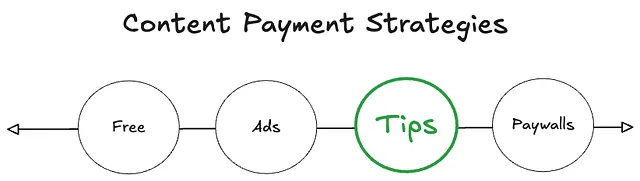
It is optional. It does not block access. It does not fragment the web. It does not force creators to choose a platform.
Today, every major social platform is reinventing tipping in isolation. YouTube, Twitch, X, Reddit, etc. There is no composible layer to view or act on this data, but the infrastructure for the payment rails already exists, they’re simply unused.
What we are missing is a universal balance (a tipping jar) that humans and agents alike can use anywhere. Imagine a Venmo-like primitive for the open web, for every social graph, with the same user experience wherever you go.
Call it micro-tipping. Call it micro-attribution. Call it micro-support. Call it a micro-donation. The important thing is that we’re not paying micro-soft.
The name matters less than the behaviour.
Tipping already exists as a social construct. We tip drivers, performers, and waiters. Whatever your opinion of tipping culture, it is not going away. It is being redefined in the AI era.
The open web needs a native way to say “this mattered” without closing itself off.
That is the story we are telling. And we think it unlocks a win for creators, users, agents, and the internet itself.